 GOAT TATTOO
Bringing an AI-Generated Tattoo Design to Your Artist: What Actually Works
Published September 25, 2026
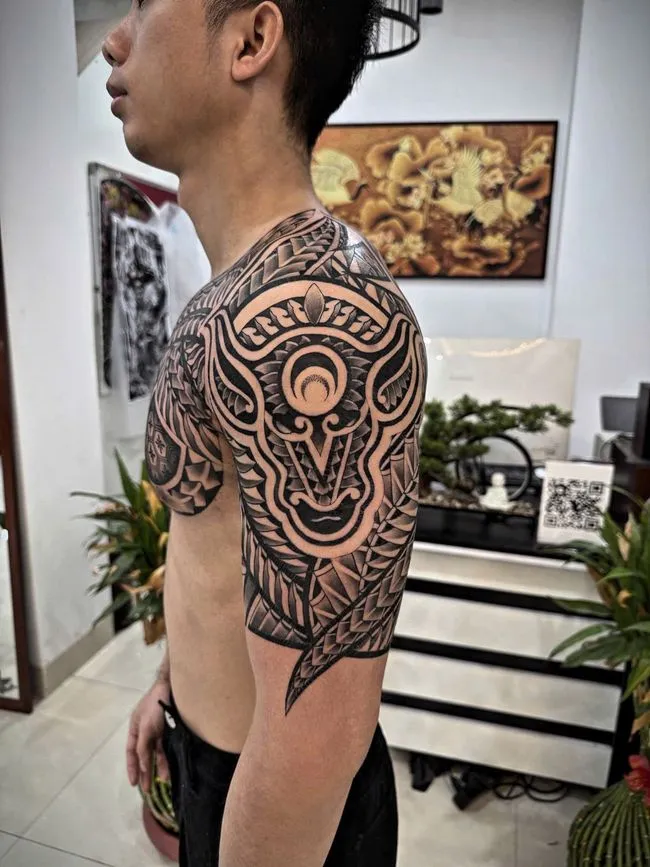
Midjourney, DALL-E, and dedicated “AI tattoo generator” apps have made it easier than ever to produce a striking image in seconds — and a lot of people now show up to a consultation with one on their phone. That’s not a problem by itself. The problem is treating that image as a finished design instead of what it actually is: a very fast, very rough starting point.
Why an AI image rarely tattoos the way it looks
AI generators aren’t drawing the way a tattoo artist draws. They’re predicting pixels that look plausible in a flat image, with no concept of how a line needs to behave once it’s actually going into skin. That shows up as real, recurring problems: lines that fade into nothing or double back on themselves in ways no needle can trace, shading built from soft gradients and noise that has no clean translation into linework or dotwork, and small details — a hand, a second eye half-hidden in fur, a chain link — that are anatomically or physically impossible to render at tattoo scale. An artist looking at this doesn’t see a design; they see a mood board with several genuinely un-tattooable choices buried in it.
There’s also a second, quieter issue: most AI-generated tattoo images are stylistic composites, blending elements pulled from countless existing tattoos and illustrations the model was trained on. That’s part of why so many AI outputs look eerily similar to each other — the same overused symmetric mandala-dragon-rose combinations show up constantly. Bring one of those in expecting something unique, and you’re actually asking to get the least original version of a design possible.
What it’s genuinely good for
None of that means skip the AI tool — it’s a legitimately useful step before you ever book. It’s excellent for figuring out what you don’t want as much as what you do: generate a dozen variations of “geometric wolf” and you’ll quickly see which proportions, densities, and styles actually appeal to you, which is real information to bring into a consultation. It’s also useful as a fast way to explore a concept — a phrase, a memory, a mix of two animals — before you’ve committed to a specific composition. Treated as a mood board rather than a blueprint, it can genuinely speed up the early, vague part of design conversations, which lines up with what good reference actually looks like — enough to communicate direction, not so locked-down that there’s no room for your artist’s judgment.
Tattoo “try-on” and AR preview apps are a related but different tool worth mentioning here too, and one of the more genuinely practical uses of this technology: rather than generating a new design, they let you preview an existing design at roughly the size and placement you’re considering, directly on a photo of your own body. That’s a real, useful way to sanity-check scale and position before you’re in the chair — something no amount of AI-generated concept art can tell you.
Bringing it to a consultation
The honest version of this conversation with your artist is simple: say upfront that the image is AI-generated and that you’re open to it changing. Point to what you actually like about it — a pose, a color palette, an overall mood — rather than asking for it to be replicated line for line. A good artist will take that direction and build something that’s actually built for skin: linework with real weight and flow, shading that holds up as it ages, and details sized so they’ll still read clearly in ten years instead of blurring into a smudge. That’s the same gap between rigid over-specification and useful direction covered in our guide to tattoo reference — an AI image is reference, not a spec, and it works best when you treat it that way.
If what you actually want is closer to a specific existing image than a jumping-off point, it’s worth understanding the difference that makes to the process — covered in our custom vs. flash comparison — since a heavily AI-composited request sits in a genuinely different category from either.
Related Guides
Ready to book your tattoo in Hanoi?
Send us your idea and preferred dates — we'll reply with a clear quote before you sit in the chair.
Book Now