 GOAT TATTOO
Ares Tattoo Meaning: Hated in Greece, Revered in Rome
Published October 29, 2026
Short answer: “god of war” is the one-line version of Ares, and it hides the strangest part of his story - the Greeks themselves barely liked him. In the Iliad, Zeus tells his own son to his face that he is “the most hateful to me of all the gods on Olympus.” Rome took the same god, renamed him Mars, and made him the second-most important deity in the entire state religion, father of the men who founded the city. Same war god, two completely opposite reputations - and which one you’re actually picturing changes what the tattoo says.
Ares shows up in most Greek-god tattoo roundups as a one-line entry next to a spear and a suit of armour, usually just “raw war and courage.” That’s not wrong, but it skips the part that makes him genuinely interesting: unlike Zeus, Athena or Apollo, Ares was never a god the Greeks were especially proud of. Here’s the scorn he got at home, the completely different welcome he got in Rome, and the myth that actually explains his symbols.
Zeus’s own words: “the most hateful to me of all the gods”
In Book 5 of the Iliad, after Ares is wounded in battle and runs crying to his father, Zeus doesn’t comfort him - he tells Ares that of all the gods on Olympus, he is the one Zeus hates most, because all Ares does is cause strife, war and fighting. It’s one of the few moments in Homer where a father speaks to his own child with open contempt, and the other gods treat Ares with the same coolness throughout the poem. The distinction the Greeks were drawing is specific: Athena represented war fought with strategy, discipline and a defensible cause, while Ares represented war for its own sake - chaos, bloodlust and violence with no higher purpose attached. The Spartans were an exception; their whole military culture genuinely honoured him. Everyone else kept their distance.
Mars: the god Rome built its state religion around
Rome took the same god, gave him the name Mars, and turned him into something the Greeks never allowed Ares to be. In Roman myth, Mars fathered Romulus and Remus with the priestess Rhea Silvia, making him the literal ancestor of the men who founded Rome itself - a legitimacy no other war god in the ancient Mediterranean can claim. He ranked second only to Jupiter in the official state religion, the month of March carries his name, and Roman legions trained on the Campus Martius, a field dedicated to him. Centuries later, Augustus built a temple to Mars Ultor - “Mars the Avenger” - specifically to mark Julius Caesar’s assassination being avenged, cementing Mars as a god of righteous retribution rather than Ares’s reputation for violence without a cause. A tattoo rooted in the Mars side of this god reads as duty, legacy and the kind of war that builds something, not the Greek version’s chaos.
Caught in Hephaestus’s net: where the spear-and-vulture symbols actually come from
Ares’s best-known myth has nothing to do with battle. In Book 8 of the Odyssey, the sun god Helios catches Ares having an affair with Aphrodite, wife of the smith-god Hephaestus, and reports it. Hephaestus forges a net of golden chains so fine it’s invisible, rigs it over his own bed, then announces the trap to the entire pantheon - who gather to watch the two lovers caught naked together, to general laughter rather than outrage. It’s one of the few scenes in Greek myth where the war god is the butt of the joke rather than the threat. His battlefield symbols - a bronze spear and helmet, and the vulture that was said to follow him onto battlefields after the fighting - sit alongside two sons by that same affair with Aphrodite: Phobos and Deimos, “Fear” and “Dread,” who rode beside him into war as living extensions of what he actually brings with him.
What actually matters when choosing
If the point is honour, duty and war fought for a cause you’d defend, Mars - and specifically Mars Ultor, the avenger rather than the aggressor - is the more precise reference to give your artist, even without his name in the design. If the point is raw, unapologetic aggression and the parts of a fight that aren’t noble, Ares in the Homeric sense is the more honest match, and the Spartans’ genuine respect for him is worth naming if that’s the angle. The spear and helmet alone read as general warrior imagery; adding the vulture, or Phobos and Deimos as a pair of smaller companion figures, signals you mean this specific god rather than “war” in the abstract. And if the appeal is partly the gossip - a god who gets humiliated instead of worshipped - the net scene is a legitimate, specific story to reference instead of a generic battle pose.
What to expect at GOAT Tattoo Studio
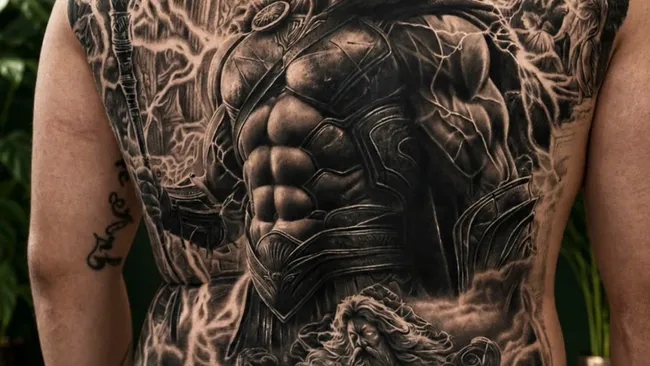
Our gallery includes a full back piece built around a helmeted, armoured warrior figure in classic black and grey marble-statue style, with lightning and columns worked into the background - the same visual language Ares and Mars are most often rendered in. At your consultation we can talk through which side of this god you actually mean - the Homeric Ares the Greeks kept at arm’s length, or the Roman Mars a whole empire built temples to - so the symbols we pair with him say what you intend. Our guide to Greek god tattoos covers how he fits alongside Zeus, Athena and the rest of Olympus, our Spartan tattoo guide covers the one Greek culture that genuinely admired him, and our Aphrodite tattoo guide covers the goddess on the other side of the net.
Related Guides
Ready to book your tattoo in Hanoi?
Send us your idea and preferred dates — we'll reply with a clear quote before you sit in the chair.
Book Now