 GOAT TATTOO
Mandala & Geometric Tattoos: What to Actually Look For
Published August 23, 2026
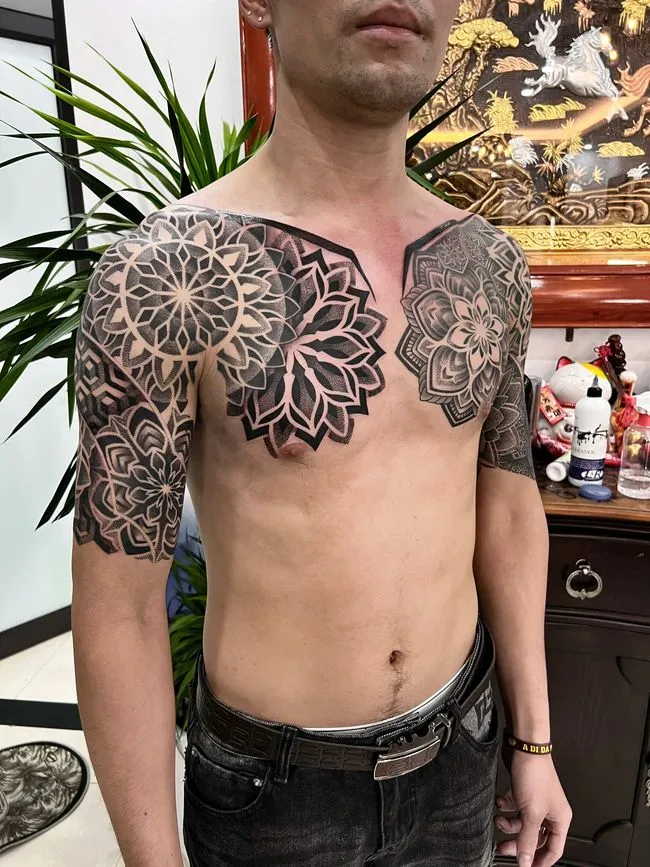
Mandala tattoos come from a real place — the word itself is Sanskrit, and mandalas are sacred circular diagrams in Hindu and Buddhist traditions, tied to the cosmos, meditation, and balance. As body art, they’re almost always adapted as decorative geometry rather than religious objects, but it’s worth knowing that history rather than treating the motif as generic “pretty geometry” — some people who see the design will still read it as spiritually significant, not purely decorative.
One thing worth clearing up before anything else: mandala isn’t really its own tattooing technique the way fine line or blackwork are. It’s a design category — a symmetrical, radial pattern — that gets built using other techniques underneath it, most often dotwork or geometric blackwork, sometimes fine line, occasionally with color worked in. So evaluating a mandala piece really means evaluating how well the artist executed whichever technique is doing the actual work.
What separates a precise mandala from a sloppy one
- Symmetry has to read cleanly from the center outward. A mandala lives or dies on radial balance — if you can spot the pattern drifting off-center or one “slice” not matching the others, that’s the clearest sign of a rushed or freehand-without-guides piece.
- Dot spacing and density need to stay consistent, for dotwork mandalas specifically. Uneven dot density is one of the fastest ways a mandala starts looking muddy rather than crisp, especially as it ages.
- Line spacing shouldn’t crowd together. Tightly packed linework can look impressive zoomed in on a fresh photo, but overly dense patterning is exactly what tends to blur and merge visually a few years down the line.
Where this style actually works best on the body
Mandala and geometric pieces genuinely favor flatter, broader areas — back, chest, shoulders, and upper arm/sleeve placements — because radial symmetry needs relatively even surface to sit on without visibly warping. It’s not that a mandala can’t work smaller or on a more curved spot, but perfect radial alignment gets noticeably harder to hold onto the more the canvas curves or shrinks.
What actually helps a mandala age well
- More open spacing ages better than tightly packed detail. The same lesson that applies to fine line work applies here — bolder outlines and clearer negative space hold up better over the years than ultra-fine dots or lines packed close together.
- Size matters more here than in a lot of other styles, simply because the whole point is a pattern that needs room to stay legible as skin changes over time.
- A confident, symmetrical design ages more gracefully than an intricate one — this is one style where “more detail” isn’t automatically “better,” since the detail is exactly what’s most at risk over the long run.
What to expect at GOAT Tattoo Studio
Browse our blackwork and tribal gallery and fine line gallery for mandala and geometric pieces — you’ll notice most of our work here leans into open spacing and confident symmetry rather than maximum density, for exactly the aging reasons above. During consultation, we’ll talk through placement and scale together, since getting the size right matters more for this style than almost any other.
Related Guides
Ready to book your tattoo in Hanoi?
Send us your idea and preferred dates — we'll reply with a clear quote before you sit in the chair.
Book Now