 GOAT TATTOO
Wrathful Deity Tattoo Meaning: Buddhist Guardians, Fire & the Third Eye
Published November 24, 2026
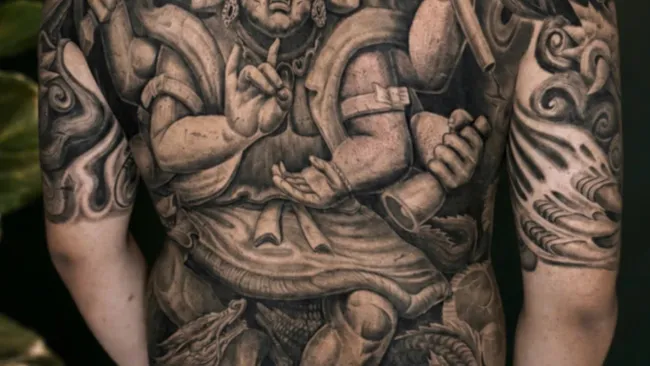
Short answer: a wrathful deity tattoo usually means fierce protection, inner strength and the courage to destroy your own fear, anger and ignorance. In Buddhist art, wrathful deities look terrifying, with fangs, bulging eyes, flames and weapons, but they are protectors, not demons. Their anger is aimed at the things that cause suffering, never at people. Well-known examples are Fudo Myoo in Japan, Mahakala in Tibet, and the guardian statues at temple gates across Asia.
These are some of the most powerful images in tattooing, and they look best large: a back piece, a chest piece or a full sleeve. This guide explains who they are, what their symbols mean and how to wear one with respect.
Why does a protector look so angry?
In Buddhism, the calm, smiling Buddha shows peace and compassion. But some obstacles do not respond to gentle methods. Wrathful deities are compassion in its fierce form, like a parent who shouts to stop a child from running into the road. Their faces frighten away evil, and their weapons cut through ignorance, greed and hatred, which Buddhism calls the poisons of the mind.
So a wrathful deity tattoo is not about violence. It is about protection, discipline and facing your own demons. People often choose one after a hard period in life, or as a guardian for themselves and their family. For the peaceful side of the same tradition, see our Buddha tattoo guide.
The best-known wrathful guardians
- Fudo Myoo (Acala): the “Immovable One”, the most popular in Japanese tattooing. He sits or stands in front of a wall of flames, holding a sword to cut through delusion and a rope to catch and pull people back to the right path. He is a strong symbol of determination.
- Mahakala: a dark, fierce protector in Tibetan Buddhism, often with several arms, a crown of skulls and a curved knife. He protects the teaching and those who follow it.
- The Nio: two muscular guardians at the gates of Japanese temples. One has his mouth open and one has it closed, the beginning and the end of all things.
- Vietnamese temple guardians: many Vietnamese pagodas have two large guardian statues at the entrance, one gentle-faced, one fierce, who encourage good and punish evil. They are a local version of the same idea.
- The Four Heavenly Kings: armoured guardians of the four directions, often painted on temple gates in China, Japan, Korea and Vietnam.
Japanese tattooing has its own fierce faces too. The hannya and the oni are demons, not Buddhist guardians, but they are often combined with them, and Raijin and Fujin are gods of thunder and wind who also guard temple gates.
Symbols and what they mean
- Flames: the fire of wisdom that burns away ignorance. The flame halo behind Fudo Myoo is the most famous example.
- The third eye: wisdom that sees the truth beyond appearances.
- A crown of skulls: in Tibetan art, often five skulls, explained as the poisons of the mind changed into wisdom. They also remind us that life is short.
- Many faces and arms: the power to see in every direction and to help in many ways at once.
- Weapons: the sword cuts through delusion, the trident and the vajra stand for unbreakable truth, the axe and the mace break obstacles.
- Fangs and a fierce face: fear for evil, protection for everyone else.
- Lotus base and dragons: purity rising from mud, and power under control.
Design and placement
Wrathful deities have a lot of detail: faces, hands, jewellery, weapons and flames. They need space.
- Full back: the classic choice. The deity fills the back, with flames above and a lotus or dragons below. See our Japanese back piece guide.
- Chest piece or half sleeve: a single face or upper body with flames.
- Full sleeve: the deity on the upper arm, flames and clouds running down to the wrist.
- Style: black and grey realism makes them look like carved stone or bronze temple statues; see the black and grey realism guide. Colour Japanese style gives bright red or blue skin and orange flames.
Wearing it respectfully
These figures are still part of living religious practice in many countries, including Vietnam. A few simple rules keep the tattoo respectful:
- Place it high: the back, chest, shoulder or arm. Many Buddhists find holy images on the feet or lower legs disrespectful.
- Do not mix it with jokes: avoid cartoon versions or adding things like cigarettes or money.
- Learn who it is: knowing the name and the story makes the tattoo mean more, and helps if someone asks.
At GOAT Tattoo Studio
The photo at the top of this page is a full back from our studio, in black and grey realism: a three-faced guardian with a third eye and a crown of skulls, holding a trident, an axe and other weapons, with flames above and a dragon and lotus below. Our gallery also has a full-colour Japanese bodysuit by Kane, with a three-eyed wrathful guardian surrounded by flames across the back and legs. A piece like this is planned over several sessions; in a consultation we choose the figure, the pose and the symbols with you. For prices and artists, see our Japanese tattoo page and our realism and portrait page.
Related Guides
- Buddha Tattoo Meaning: Devotion vs. Decoration
- Japanese Back Piece Tattoo Guide: Subjects, Background & Sessions
- Hannya Mask Tattoo Meaning: Rage vs. Sorrow
- Oni Mask Tattoo Meaning: Demon, Protector or Both?
- Raijin and Fujin Tattoo Meaning: Japan's Thunder and Wind Gods
- Foo Dog Tattoo Meaning: Shishi, Komainu and Vietnam's Nghê
- Black & Grey Realism Tattoos: What to Actually Look For
Ready to book your tattoo in Hanoi?
Send us your idea and preferred dates — we'll reply with a clear quote before you sit in the chair.
Book Now