 GOAT TATTOO
Ganesha Tattoo Meaning: Remover of Obstacles & Respect Rules
Published October 29, 2026
Short answer: a Ganesha tattoo means new beginnings, wisdom and the removal of obstacles. Ganesha is the elephant-headed Hindu god who is prayed to first, before any new journey, business, exam or marriage, so a Ganesha tattoo is usually a request for a clear path ahead. Because he is a living god worshipped by hundreds of millions of people, the rules of respect matter: keep him above the waist, never on the feet, and design him with his correct symbols.
Ganesha (also Ganesh, Ganapati or Vinayaka) is one of the most loved gods in Hinduism, and his image is also found in Buddhist Thailand and Japan. Here is what each part of his image means and how to get it right as a tattoo.
Who Ganesha is
Ganesha is the son of Shiva and Parvati. His best-known names say what he does: Vighnaharta, the remover of obstacles, and Vighneshvara, the lord of obstacles, because he can also place obstacles in the way of people who need to slow down. Hindus traditionally pray to him at the start of every ceremony, and his image is placed at the entrance of homes, shops and new offices. He is also the patron of writers, students and the arts.
Why he has an elephant head
The most common story says Parvati made a boy and set him to guard her door. When Shiva came home, the boy refused to let him in, and Shiva, not knowing who he was, cut off his head. To comfort Parvati, Shiva replaced it with the head of the first creature found, an elephant, and made the boy the leader of his followers (the ganas, which is where the name Ganapati comes from). The tattoo meaning that comes from this story is rebirth after loss and a second chance.
What each symbol means
- The elephant head: wisdom and a big mind; the large ears are often read as listening more than you speak.
- The broken tusk: sacrifice. In one well-known legend Ganesha broke off his own tusk to keep writing the epic Mahabharata when his pen failed.
- The mouse (Mushika): his vehicle. A tiny animal carrying a huge god means controlling desire and ego, and that small things can move large ones.
- Modak sweets: the reward of spiritual effort. They are usually shown in his hand or bowl.
- The axe, noose and lotus in his hands: cutting attachments, pulling you toward the right path, and purity.
- The big belly: the ability to take in both the good and the bad of life.
Left or right trunk?
Most Ganesha images have the trunk curving to the god’s left. This form is seen as calm and suitable for homes. A trunk curving to the right is traditionally considered more powerful and strict, linked to temples and careful ritual. Many Hindus prefer a left-turned trunk for a tattoo; if you are unsure, ask someone from the tradition, or choose the left.
Respect rules for a Ganesha tattoo
- Placement: upper arm, shoulder, chest, upper back or forearm. Avoid the feet, ankles, lower legs and below the waist; in Hindu culture feet are considered unclean, and a god on the feet causes real offence.
- Do not mix him with joke or horror elements, such as skulls, guns or cartoon parody.
- Travel: religious tattoos can cause offence in parts of South Asia; Sri Lanka once deported a tourist over a Buddha tattoo. If you are travelling there, a placement you can cover with a T-shirt is a safe choice.
- Meaning: you do not have to be Hindu, but it is worth knowing the story so you can explain it with respect when someone asks.
Ganesha in Thailand and Japan
In Thailand he is Phra Phikanet, the patron of the arts and of new beginnings, and his statues are common at art schools and businesses. In Japanese esoteric Buddhism he became Kangiten, a protective god often shown as two figures embracing. A design that draws on these traditions looks different from an Indian one, so tell your artist which source you mean.
Design ideas
- Fine-line or dotwork Ganesha on the forearm, with a lotus base.
- Ganesha inside a mandala, which suits the upper back or a sleeve; see our mandala and geometric style guide.
- The Om symbol woven into his trunk or forehead, a traditional pairing.
- Black and grey realism of a temple statue, which needs at least a palm-sized area for the face and hands to stay clear.
- Sanskrit mantra such as “Om Gam Ganapataye Namah”; have the Devanagari checked, as in our Sanskrit lettering guide.
At GOAT Tattoo Studio
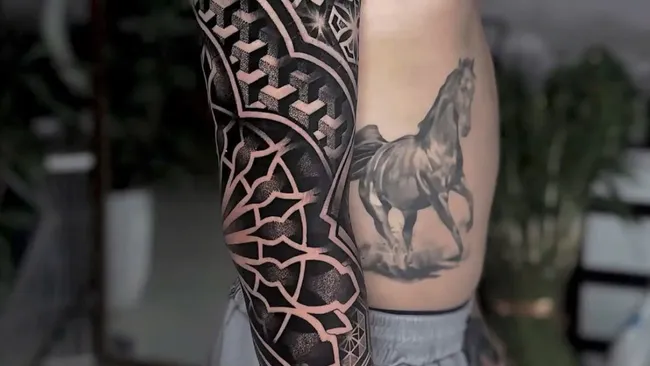
We do not have a finished Ganesha piece in our gallery yet, so we will draw yours from scratch rather than copy a flash design. Bring any reference images you like, tell us which story or symbols matter to you, and we will check the details (the number of arms, the trunk direction, the objects he holds) before the stencil goes on. Our mandala sleeve and dotwork work shows the line style we use for this kind of piece, and our mandala and geometric tattoo page lists prices and artists.
Related Guides
- Elephant Tattoo Meaning: Ganesha & the White Elephant
- Hindu Tattoo Symbols: Om, Shiva, and Trishul Meanings
- Om Tattoo Meaning: Hindu vs. Buddhist vs. Jain
- Shiva Tattoo Meaning: Destroyer Is the Wrong Word
- Lotus Tattoo Meaning: Buddhist Symbol vs. Vietnam's National Flower
- Getting a Sanskrit or Hindi Tattoo: What to Know First
- Mandala & Geometric Tattoos: What to Actually Look For
- Religious and Spiritual Tattoo Symbols: What to Actually Know
Ready to book your tattoo in Hanoi?
Send us your idea and preferred dates — we'll reply with a clear quote before you sit in the chair.
Book Now