 GOAT TATTOO
Large Tattoos vs. Small Tattoos: A Real Skill Test
Published August 19, 2026
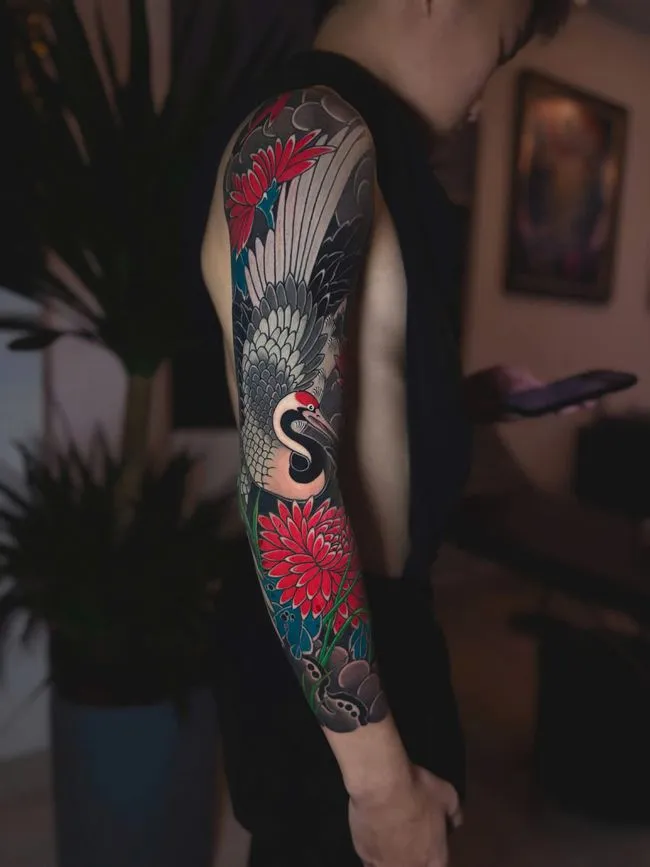
If you’ve browsed our gallery, you’ve probably noticed it: a lot of full backs, full sleeves, and other large-scale pieces, and comparatively fewer small ones. That’s not an accident, and it’s not because we don’t do small tattoos — we do plenty. It’s because large-scale work is a genuinely harder test of what an artist can actually do, and it’s the clearest way to show it.
A small tattoo only has to solve one problem. A large one has to solve all of them at once.
A small tattoo — a fine-line flower on a forearm, a small lettering piece — succeeds mainly by being one clean, well-executed image in one sitting. That takes real precision (there’s no room to hide a shaky line at that scale), but it’s a narrow test: one design, one skin condition, one session, done.
A full sleeve or back piece is a completely different kind of problem. The artist has to get right, all at once:
- Composition across an irregular 3D surface. The body isn’t a flat canvas — a sleeve has to wrap the shoulder cap, follow the curve of the inner and outer arm, and taper correctly toward the wrist. A back piece has to work with the spine, shoulder blades, and the way skin moves when someone lifts their arms. A design that looks right laid flat on paper can look wrong the moment it’s actually on a body in motion.
- Flow, not just placement. The strongest large pieces are designed so the eye moves naturally through them — from shoulder to wrist, or top to bottom of a back — rather than getting stuck on one busy section with empty space everywhere else. That’s a composition skill, not just a drawing skill.
- Consistency across many hours and multiple sessions. A full back or sleeve is rarely finished in one sitting — it’s usually broken into several sessions spread weeks apart for healing. The artist has to recreate the same line weight, the same saturation, the same shading logic in session three that they used in session one, often on skin that’s changed slightly since the last visit. Get this wrong and the piece has visible “seams” where one sitting ends and the next begins.
- Even color and shading over a large continuous area. It’s one thing to shade a small patch evenly. It’s much harder to keep saturation and value consistent across an entire back without patchiness, especially once you’re blending multiple sessions together.
- Stamina without losing control. Large pieces often mean long sessions — several hours at a stretch, sometimes multiple times. Hand speed, needle depth, and packing consistency all have to hold steady even hours in, when fatigue is working against precision.
None of that shows up in a small tattoo, no matter how well it’s executed. A small piece proves an artist can draw and execute cleanly. A large piece proves they can plan, adapt to anatomy, sustain quality over time, and make dozens of individual decisions add up to one coherent piece of art on a moving, living surface.
Why this matters when you’re choosing an artist
This is also the honest answer to “how do I actually judge a portfolio, beyond just liking the pictures?” Small tattoos are relatively easy to make look good in a single photo — tight crop, good lighting, one clean image. Large-scale work is much harder to fake or flatter in a photo, because the flaws that matter (awkward flow, visible session breaks, uneven shading, elements that feel stitched together rather than connected) are exactly the things a rushed or less experienced artist struggles to hide.
So when you’re comparing studios or artists, full pieces are the more reliable signal. If an artist’s large work looks cohesive — the design genuinely moves with the body, the shading is even from top to bottom, there’s no obvious “this session doesn’t match that one” — that’s a much stronger indicator of real technical control than a handful of nice small tattoos alone.
Why our gallery is full of large pieces
This is the direct reason our gallery leans so heavily toward full backs, sleeves, and other large-scale work: it’s where our artists’ actual skill level is easiest to verify. Anyone can show you a nice small tattoo. Not every studio can show you a full back piece with clean composition, consistent shading across every session, and a design that flows naturally with the body — that takes a different level of planning and control, and it’s genuinely harder to get right.
We still do plenty of small, fine-line, and single-session pieces, and we care about those just as much in the chair. But if you want to judge what a studio can really do at its ceiling, look at the large work first.
What to expect if you’re planning a large piece
Big pieces mean more planning up front — placement, flow, and composition get worked out in consultation before any needle touches skin — and they’re usually completed across multiple sessions rather than one long sitting, with healing time built in between. If you’re curious how that’s actually scheduled, our guide on how long a tattoo session takes breaks down what to expect session by session.
Related Guides
Ready to book your tattoo in Hanoi?
Send us your idea and preferred dates — we'll reply with a clear quote before you sit in the chair.
Book Now