 GOAT TATTOO
Spearhead Tattoo Meaning: Warrior, Provider, and Shaka's Iklwa
Published October 26, 2026
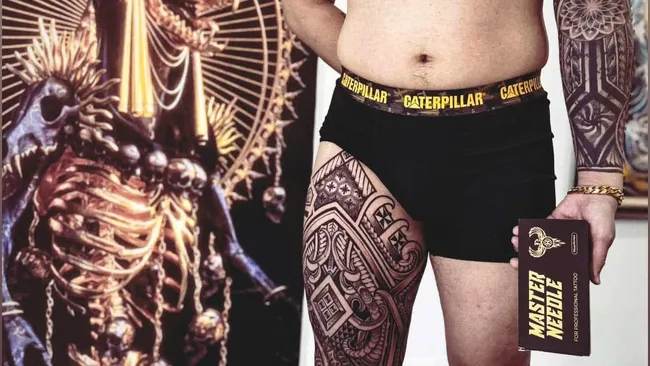
Short answer: a spearhead tattoo generally means courage, readiness, and protection — a blade built for a single decisive moment rather than prolonged conflict. In Polynesian and Samoan tattooing it carries a double meaning of warrior and provider, since the same tool hunted and fished as often as it fought, and it appears at the end of the ancestral canoe line in the traditional Samoan pe’a. In Zulu tradition, the short stabbing iklwa carried its own strict code of honour under the 19th-century king Shaka — a warrior was never to throw it away, and never to return from battle without it.
The shape is simple — a narrow triangle or diamond on a shaft — but it’s one of the oldest tools humans ever turned into a weapon, which is part of why it shows up across so many unrelated tattoo traditions with a similar core meaning: readiness, direction, and a willingness to act decisively.
Polynesia and Samoa: warrior and provider in one symbol
Across Hawaiian, Tahitian, and Samoan tattooing, the spearhead (often drawn as a repeating diamond or triangle pattern — sometimes called matakirea in Polynesian design vocabulary) reads as both a warrior’s emblem and a provider’s mark, because the same spear that defended a family also caught fish and game for it. That double meaning is part of why the symbol carries weight beyond pure aggression — it’s as much about responsibility as it is about combat. In the traditional Samoan pe’a — the sacred, full lower-body tattoo described in our Polynesian and Samoan tattoo symbols guide — spearhead motifs sit at the ends of the ancestral canoe line specifically, a detail read as a young man now being ready to steer his own canoe and provide for his own household, not just carry on his family’s. Outside the pe’a itself, the same motif is one of the most common repeating elements in larger Polynesian-tribal sleeve and leg work, including the Maori and Polynesian pieces our specialist Linker designs — see our Maori tattoo symbols guide for how it sits alongside koru, hei matau, and manaia in that shared visual vocabulary.
Zulu Southern Africa: Shaka’s iklwa and the rule against throwing it away
A completely separate tradition gives the spearhead a different, equally specific meaning. In the early 1800s, the Zulu king Shaka is widely credited with reforming Zulu warfare around a short, broad-bladed stabbing spear known as the iklwa — named, by one common account, for the sound it made being pulled from a wound. Where the older, lighter throwing spear (the assegai) was used at range to soften an enemy line before the charge, the iklwa was a close-combat weapon that forced a warrior to fight at arm’s length rather than retreat and throw from a distance. That shift came with a strict code: a Zulu warrior was never permitted to throw his iklwa away, and never permitted to return from battle without it — losing it was treated as equivalent to cowardice. Later, ornately decorated versions of the spear were reserved for chiefs specifically, as a mark of authority rather than a weapon meant for use. A spearhead read through this tradition leans less on “provider” and more on discipline, honour, and a refusal to retreat.
Direction, pairing, and pattern: what the design itself changes
- Single spearhead, point up: the most straightforward reading — forward motion, readiness, a decision already made.
- Repeating diamond or triangle rows: the Polynesian pattern use described above, often running down the length of a larger sleeve or leg piece as a structural border rather than a standalone symbol.
- Two spearheads crossed: a widely used general design convention (not specific to either tradition above) for conflict resolved, an alliance, or a battle survived rather than ongoing hostility.
- Paired with a shaft or feathers: leans the design toward a specific weapon-culture reference — Polynesian, Native American, or otherwise — rather than the abstract blade shape alone.
What actually matters when choosing
Decide first which of the two real traditions above you actually mean, because they carry genuinely different weight: a Polynesian-rooted piece sits inside the broader tribal design vocabulary our Maori and Polynesian specialist works in daily, while a Zulu-rooted iklwa reference is a specific, documented piece of Southern African military history that’s worth naming honestly rather than treating as generic “warrior” clip art. If you’re drawn to the shape purely for how clean and graphic it looks as a repeating pattern, that’s a legitimate reason on its own — just say so at your consultation rather than letting the artist guess which story you want it to tell.
At GOAT Tattoo Studio
Linker, our Maori and Polynesian specialist, works with spearhead and diamond-pattern motifs regularly as part of larger tribal sleeve and leg pieces — see recent work in our Maori-Polynesian gallery. At consultation we can talk through whether you want the Polynesian warrior-and-provider reading, a nod to a specific tradition like the Zulu iklwa, or simply the shape itself, and build the composition around that.
Planning a Maori or Polynesian tattoo in Hanoi? Our Maori & Polynesian tattoo page has prices, the artists who do this style, and recent work.
Related Guides
Ready to book your tattoo in Hanoi?
Send us your idea and preferred dates — we'll reply with a clear quote before you sit in the chair.
Book Now