 GOAT TATTOO
Dotwork & Stippling Tattoos: What to Actually Look For
Published August 30, 2026
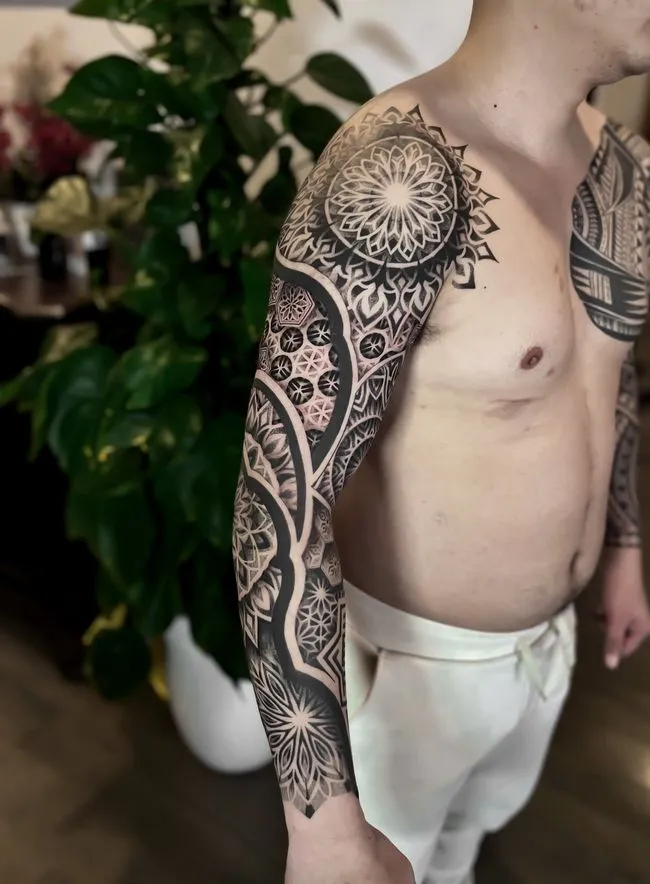
Dotwork, sometimes called stippling, builds an entire image — shading, texture, gradients, even the illusion of solid fill — out of individual dots rather than continuous lines or shaded fields. It’s genuinely a technique rather than a single subject matter, which is why you’ll see it show up inside mandala work, blackwork compositions, fine-line botanical pieces, and standalone geometric or abstract designs. It’s worth understanding as its own thing, since the skill involved is quite different from linework-based styles even when the final image looks similar.
How it actually creates shading and depth
Instead of a single shaded gradient, dotwork builds depth through dot density and spacing — areas meant to look darker get more tightly packed dots, and lighter areas use sparser, more spread-out placement, with the transition between the two creating the illusion of a smooth gradient from a distance. This is a genuinely different skill from traditional shading with a shading needle grouping, and it takes real time: a densely packed dotwork piece can take meaningfully longer per square inch than a comparable linework or solid-shaded piece, since every dot is placed individually rather than built with continuous passes.
Where it overlaps with other styles
Our mandala & geometric guide covers how mandala pieces are often built with dotwork specifically, since the technique suits radial, repeating patterns particularly well — precise, evenly spaced dots hold symmetry better than freehand shading does. Dotwork also shows up inside blackwork pieces as a way to build gradients and texture without switching to solid black fill, and inside fine-line botanical work as a way to add soft shadow without thickening any of the linework itself. This crossover is normal — dotwork is rarely the entire tattoo on its own, more often a technique layered into a broader style.
What actually separates strong dotwork from weak work
- Consistent dot size and spacing within each shading zone. Dots that vary randomly in size rather than following a deliberate density gradient tend to look messy up close rather than smooth from a distance.
- Genuinely smooth transitions between density zones, without a visible hard edge where dense dotting suddenly switches to sparse. A hard line there usually means the artist rushed the transition instead of gradually stepping the density down.
- How it heals, not just how it looks fresh. Because dotwork depends on very fine, precise dot placement, ask to see healed examples specifically — poor technique can cause dots to blur together or fade unevenly in a way that’s not obvious in a fresh photo.
What to expect at GOAT Tattoo Studio
Browse our fine-line gallery and blackwork gallery for examples of the precise, controlled technique that carries directly into strong dotwork — we’ll talk through how much of your piece should lean on dot-based shading versus solid linework at your consultation.
Related Guides
Ready to book your tattoo in Hanoi?
Send us your idea and preferred dates — we'll reply with a clear quote before you sit in the chair.
Book Now