 GOAT TATTOO
How to Choose a Style for Your Full Back, Sleeve, or Leg Tattoo
Published September 16, 2026
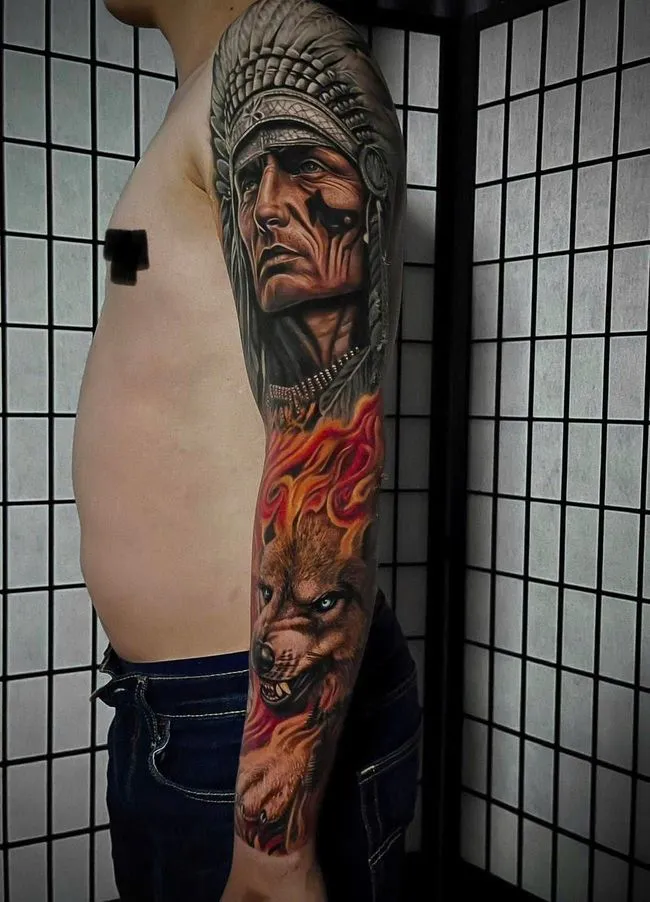
Committing to a full back, full sleeve, or full leg is a decision most people only make once or twice in their life, and the question that actually matters most isn’t “how much does it cost” — it’s “which style is right for this piece.” Style is what decides the price tier you land in, but it also quietly decides how many sessions you’ll sit through, how much the shading will test your patience on hour four, how the piece reads from across a room in ten years, and whether it still feels like you once it’s finished. This guide walks through the real differences between the styles we offer for full-coverage work, and how to actually choose between them instead of defaulting to whatever’s trending.
The 8 styles available for a full-coverage piece
These are the exact style categories in our full-piece package pricing, and each one behaves differently once it’s covering an entire back, sleeve, or leg.
- Sketch-style / fine-line / dotwork — relies on line density and stippled texture rather than solid color fill. The fastest category to complete at full scale, which is also why it’s the most affordable tier ($1,100 and up depending on placement).
- New Japanese (black & white) — bold modern linework drawing on traditional Japanese motifs (dragons, waves, koi, florals) without full color saturation.
- New Japanese (color) — the same modern Japanese approach with full color, which adds real time for shading and color transitions across a large surface.
- Traditional Japanese (black & white) — the older Irezumi-influenced approach, built around continuous composition (wind bars, water, clouds connecting separate motifs into one flowing piece), without color.
- Traditional Japanese (color) — the classic, most recognizable full-back and full-sleeve look, and typically the most time-intensive Japanese option because of how much of the surface gets fully colored.
- Realism (black & grey) — photographic detail through smooth gradients and precise shading, no bold outlines to hide behind.
- Realism (color) — the same photographic approach in full color, which is genuinely difficult to execute well at scale and reflects that in both price and session count.
- Maori / Mandala — bold geometric and tribal patterning, usually solid blackwork or high-contrast linework, distinct from both the Japanese and realism families.
What actually changes with style, beyond the price tag
Time investment. A sketch-style full sleeve and a color realism full sleeve can both be “one sleeve,” but they are not close to the same project. Color realism and full-color Japanese pieces require multiple passes of shading and color layering to hold up at close range — that’s real time added to the piece, not a bigger design. If your schedule or travel window is tight, this matters as much as budget.
How the pain accumulates. Line-heavy styles (fine-line, dotwork, black & white Japanese) tend to feel more consistent session to session, since the technique doesn’t change much across the piece. Heavy shading and color work — realism especially — puts more repeated passes over the same skin, which some clients find more fatiguing over a long session even at the same total hours. Neither is “worse,” but it’s worth knowing before you’re four hours into session three.
How it reads at a distance vs. up close. Traditional Japanese and Maori/Mandala pieces are built to be read as a whole — the composition is designed to work from across a room, which is part of why they suit full backs and full sleeves so well historically. Realism rewards close inspection more than distance; a stunning realism piece can look comparatively flat as a silhouette. If you want a design that “announces itself” walking past someone, that’s a real factor in the decision, not an aesthetic afterthought.
How it tends to age. Bold, high-contrast linework (traditional Japanese, blackwork Maori/Mandala, dotwork) generally holds its readability longer as ink softens over the years, because the design doesn’t depend on subtle gradients staying crisp. Fine gradients in realism and soft color transitions are more vulnerable to looking “muddier” a decade out, which is worth knowing going in — not a reason to avoid realism, but a reason to plan for touch-ups further down the line. Our guide to how tattoos fade over time covers this in more depth for smaller pieces, and the same physics apply at full scale.
A framework for actually deciding
Most people land in one of two decision paths:
- Budget-first: if the ceiling for your project is fixed, start from our full-piece price list and work backward — sketch-style/dotwork and black & white Japanese give you the most full-coverage design for the lowest total cost, without meaning a “lesser” tattoo.
- Style-first: if you already know you want a traditional Japanese back piece or a color realism sleeve specifically, the budget follows the style — and knowing the real number upfront (not a vague “it depends”) lets you plan the timeline and payment schedule honestly from day one.
Either way, placement matters too. A full back gives Japanese-style composition room to breathe across a wide, mostly flat canvas — one reason it’s a classic pairing. A full sleeve wraps around a cylindrical, moving surface, which realism and dotwork both handle differently than a flat back does; our guide to large-tattoo composition and design goes into how an artist actually plans a design around your specific body, not a generic template.
How this compares to pricing outside Vietnam
For context: a full sleeve tattooed by an experienced artist in the US or Europe commonly runs $3,500 to $12,000+ in total, depending heavily on artist reputation and city. Our full-sleeve packages run $1,100 to $3,600 depending on style — a real difference, not a marketing number, and one of the concrete reasons travelers plan a large piece around a Hanoi trip specifically. The tradeoff isn’t quality; it’s that a large piece still needs multiple sessions spaced for healing, so it needs to fit your actual travel timeline, not be squeezed into a single visit.
What to expect at GOAT Tattoo Studio
Every price and style listed above is real, from our current full price list — not a placeholder range. Linker, our most experienced artist with 10+ years and multiple tattoo awards in Vietnam and Taiwan, along with Kien and Gau, specifically specializes in large-scale, technically demanding pieces across every style on this list. Bring your reference images to a free design consultation and we’ll help you land on the right style for your specific idea, timeline, and budget — not just the one that’s trending this year.
Related Guides
Ready to book your tattoo in Hanoi?
Send us your idea and preferred dates — we'll reply with a clear quote before you sit in the chair.
Book Now